Due Diligence in the Dark: How an AI-Empowered Source Code Audit Framework Sees What Humans Can’t

In today’s software-driven M&A landscape, the most critical risks hide inside the source code—yet, in many transactions, that code can’t be shared, cloned, or even discussed openly. Executives must sign multi-million-dollar agreements with only partial visibility into a product’s true condition.
Modern AI-based audit frameworks close that gap. Using automation, metadata analysis, and machine reasoning, they deliver full technical due diligence without disrupting operations or breaching confidentiality. They reconstruct software quality, security, and maintainability from trace data—commit history, dependency patterns, code aging, and license lineage—rather than raw code itself.
This paper outlines four real-world due diligence scenarios demonstrating how a modular, AI-driven approach can extract verifiable insights under the most restrictive conditions:
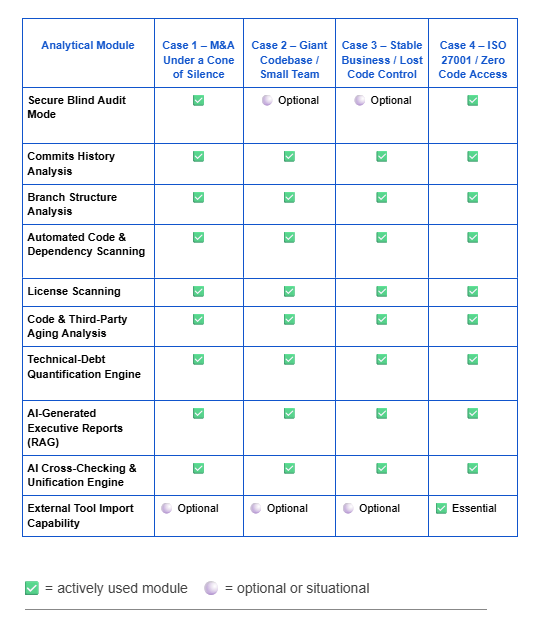
Every modern due diligence audit—whether blind (without source code sharing), local, or fully isolated—relies on a consistent foundation of analytical components.
These modules extract, correlate, and interpret technical, legal, and organizational signals within a software product, even when developer access or live code visibility is restricted.

In some acquisitions, secrecy is absolute. Only a few senior executives know a transaction is underway; developers remain unaware to prevent leaks or resignations before closing. For the buyer, that silence creates a major blind spot: no one inside the target can discuss or expose the codebase.
Working under nondisclosure and without involving developers, the audit framework executed a blind audit using a neutral administrator. A single encrypted metadata file—containing dependency maps, quality metrics, and commit-history signatures but no readable code—was exported and analyzed off-site.
From that dataset, the system generated a full executive report:
Outcome: The buyer obtained a quantified picture of code quality, security posture, and maintenance risk—without alerting the engineering team or breaching confidentiality. The findings informed valuation and post-deal stabilization.


Some M&A targets operate massive legacy platforms maintained by only a handful of engineers. In this engagement, the audit framework processed approximately 300 million lines of code across 750 repositories—a scale that made both speed and automation critical.
Outcome: Within four days, the acquirer obtained a quantified view of the codebase’s scale, risk, and staffing requirements. The results supported a valuation adjustment, a modernization roadmap, and a post-acquisition plan to triple the engineering team to restore sustainable velocity.
Summary Table


Some companies maintain strong financials while their technology quietly decays. This audit exposed a codebase that functioned—but had lost internal ownership.
Outcome: The buyer adjusted valuation, prioritized modernization, and re-established architectural ownership—turning silent technical decay into measurable, negotiable data.
Summary Table
Based on aggregated data from DXC Technology (2023) and McKinsey & Company (2020), which estimate that unmanaged technical debt typically equals 1.5–2.0× annual R&D effort required for remediation.

In highly regulated environments—finance, healthcare, and defense—auditors often operate under ISO 27001 policies that prohibit external access to source code. To operate under these restrictions, frameworks such as C2M offer three secure deployment models.
Executed on-premise with limited outbound connectivity via whitelisted ports. Performs full automated analysis while keeping the source code local.
Runs on an isolated workstation completely disconnected from networks. The scan output—encrypted metadata containing structure, dependencies, and metrics—is manually transferred for centralized AI aggregation.
Imports existing reports from tools such as SonarQube, Trivy, Fossology, Mend.io, Checkmarx, or Black Duck Hub. The analytical engine merges and normalizes the data, producing a unified RAG-level summary.
Outcome: All three models deliver the same result—a full technical, security, and compliance audit—without exposing code or violating ISO 27001 policies.
Summary Table

Across all four cases—silent acquisitions, understaffed teams, unmanaged legacy systems, and fully restricted ISO environments—the same principle holds: you don’t need to read the code to understand its risk.
By combining metadata extraction, AI reasoning, and interoperability with open-source and commercial scanners, these frameworks turn opaque codebases into measurable, comparable assets.
Executives gain a defensible financial and operational view of software health, while development teams remain undisturbed.
In a world where software defines enterprise value, modular AI-based due diligence turns blind trust into verifiable knowledge.

Is your AI technology stack becoming riskier over time without you noticing? This article presents a year-over-year analysis of 25 leading open-source AI frameworks, revealing that while most continue to innovate rapidly, many are also accumulating structural complexity and technical debt. It introduces the concept of "Debt Drift" and explains why monitoring the trajectory of code quality—not just point-in-time metrics—is essential for managing enterprise AI risk and building resilient AI platforms.

AI accelerates software development—but it doesn't eliminate the need for software governance. This article explains why enterprise AI adoption requires independent visibility into code quality, technical debt, ownership, and systemic risk. Drawing on real-world evidence, including C2M's analysis of Anthropic's open-source ecosystem, it demonstrates why governance becomes more—not less—critical as AI increases development velocity and code volume.

This article explores why many AI software initiatives fail to deliver expected returns—not because of the AI tools themselves, but because the underlying codebases are not structurally prepared. Drawing on a benchmark of 350 repositories assessed by four leading LLMs and CodeWeTrust's structural scanner, it introduces a data-driven approach to identifying where AI integration can succeed safely and where it is likely to struggle.