AI-Assisted Development Does Not Remove the Need for Codebase Governance
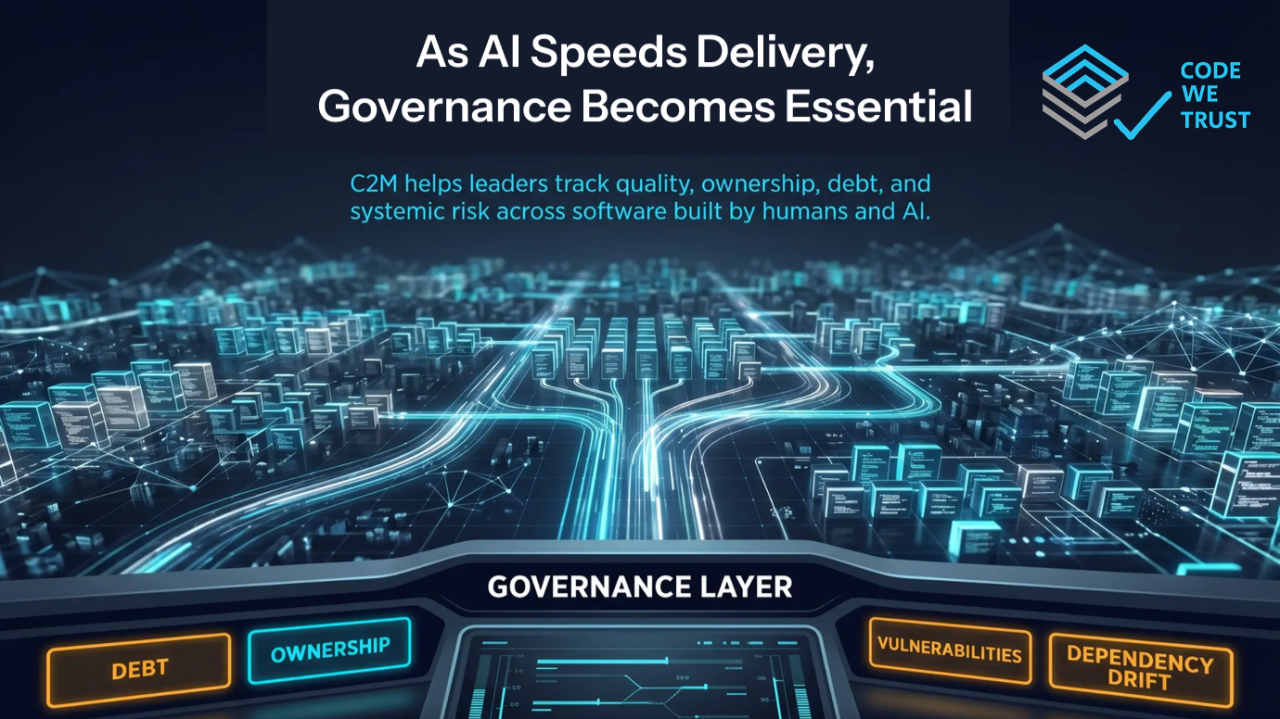
A Strategic Assessment for Technology & Business Leaders
AI-assisted development accelerates code creation. It does not replace the need for independent, portfolio-level visibility into the health of the software estate.
AI-assisted programming is rapidly transforming software delivery worldwide. Engineering teams are leveraging copilots, autonomous agents, code generators, and large language models (LLMs) workflows to compress development cycles. This shift delivers tangible value: faster prototyping, reduced repetitive work, improved documentation, and increased delivery speed.
However, a dangerous misconception is emerging among some organizational leaders: the belief that broader code analysis, quality oversight, and portfolio-level governance tools are becoming obsolete because ‘AI will take care of the code.’ This conclusion is not only overly simplistic—it introduces significant strategic risk to the enterprise.
As software creation becomes faster and more automated, software governance becomes more strategic, not less. This briefing outlines why AI-assisted development necessitates a robust, complementary governance layer to maintain visibility, control, and quality ownership across the codebase.

The argument against continued investment in codebase governance typically follows this logic: if AI can write code,
Review code, suggest fixes, and patch vulnerabilities. Why do organizations still need tools to assess maintainability, ownership, quality trends, technical debt, security posture, or dependency exposure?
It is a fair question. AI undeniably improves local productivity. It supports implementation, remediation, and even aspects of code review. However, code generation and codebase governance are fundamentally different disciplines.
AI facilitates the production and modification of co
de. It does not, by default, offer an independent assessment of the entire software ecosystem’s health. Each tool in the development stack answers a narrow question:

Despite the capabilities of AI tools, engineering leaders and the C-suite still require answers to broader, systemic questions that no single tool in the current stack addresses: Is software quality improving or deteriorating over time? Where is technical debt accumulating, and at what rate? Which modules are becoming prohibitively difficult to maintain? Where are ownership gaps emerging within the codebase? Is accelerated delivery increasing hidden, systemic risk? Which areas demand immediate management intervention?

These are governance questions, not generation questions. They require a macro-level perspective that AI coding assistants are not designed to provide
“A team adopts AI coding assistants across multiple squads and quickly increases delivery throughput. New wrappers, integrations, helper services, and generated test code appear across dozens of repositories. Velocity looks strong at sprint level. But within months, no one can clearly answer who owns which modules, where defects are clustering, or which repositories are becoming structurally fragile. The problem is not output. The problem is loss of visibility. At that point, portfolio-level governance becomes essential. “To illustrate the critical need for independent governance in AI-accelerated environments, C2M conducted a comprehensive technical due diligence scan of the Anthropic Open Source Software (OSS) ecosystem in April 2026.¹ This analysis encompassed 77 repositories and over 6.26 million lines of code (LOC), providing a stark, empirical view of what happens when output volume outruns curation.
The findings dismantle the naive assumption that organizations utilizing advanced AI inherently produce pristine code. Instead, the data reveals that AI accelerates code production far more easily than it accelerates engineering discipline.

The presence of an AI agent as the second most prolific contributor fundamentally alters the governance landscape. When a development organization can generate code, wrappers, SDKs, and integrations at machine speed, the central challenge shifts from ‘can we write it?’ to ‘can we govern it?’
The Anthropic OSS scan is not an indictment of AI capabilities; it is a textbook example of a systems management failure under accelerated production conditions. It proves that AI-assisted development does not cancel scale entropy—it often exacerbates it.
AI does not eliminate the need for codebase oversight; in many critical ways, it amplifies it. As AI accelerates the pace of delivery, engineering teams often produce more changes, more files, more wrappers, more experiments, and more complex code paths in significantly less time. While this increased output can be beneficial, it simultaneously increases review pressure and makes it exponentially harder for human reviewers to maintain a clear, comprehensive picture of the entire system.
The primary risk is not simply that AI can generate incorrect code—humans are also prone to errors. The deeper, more insidious risk is that AI-generated code often appears plausible enough to reduce human skepticism while simultaneously increasing the volume of code produced. This dynamic creates a compounding set of enterprise risks:

AI coding assistants are accelerators. C2M is the instrument panel. Driving faster does not eliminate the need for instruments—it makes them non-negotiable.
C2M is not positioned as a replacement for AI coding tools, compilers, security scanners, or software composition analysis (SCA) tools. Instead, it serves as a complementary governance layer designed specifically for software built and evolved by both humans and AI systems.
Its primary function is to help organizations understand the true condition of their codebase at scale, providing actionable intelligence across six critical dimensions: Code Quality & Trends, Technical Debt Accumulation, Ownership Concentration & Gaps, Risk Trends & Architectural Signals, Dependency & License Exposure, and Maintainability Hotspots.

AI can suggest hundreds of local fixes across a codebase, from refactors to package upgrades to security remediations. But organizations still need to know which interventions matter most. Not every issue carries the same business impact. A governance layer helps distinguish between cosmetic cleanup and strategically important remediation by identifying hotspots, ownership gaps, concentration of risk, and debt accumulation trends.

The appropriate strategic message is not that AI adoption should be slowed or curtailed. The correct stance for executive leadership is that AI-assisted development works best when paired with independent, objective visibility into code quality and codebase risk.
Organizations operating in an AI-accelerated environment do not need fewer signals; they need better, more comprehensive ones. C2M provides this broader view, supporting engineering teams, technical leaders, investors, and operators who need to understand not just what code was generated today, but what kind of software estate is being built over time.
This becomes especially important in board-level oversight, investor review, and technical due diligence. In AI-assisted development environments, rising code volume, high commit activity, and rapid feature output can create a misleading impression of engineering strength. A company may look highly productive while its software estate accumulates dependency risk, fragmented ownership, duplicated logic, and technical debt. Governance tools help leadership distinguish visible productivity from underlying software health.
In an AI-assisted delivery model, quality ownership must remain explicit. Code written by a human, a copilot, or an autonomous agent still becomes part of a long-lived software asset. If no one owns its maintainability, risk posture, and lifecycle consequences, the organization is not accelerating safely; it is accumulating unmanaged liability.

As software creation becomes faster and increasingly automated, software governance is no longer a purely technical hygiene issue. It is becoming a strategic leadership concern with direct implications for resilience, valuation, execution speed, and risk control. The organizations that will lead in the next five years will not be those that simply generate more code with AI. They will be the ones that pair AI-driven velocity with disciplined, independent oversight of the software assets that underpin their business.
C2M helps make that oversight practical. It gives organizations a clearer view of quality, ownership, technical debt, and systemic risk across code written by human developers, copilots, and autonomous agents alike. In an AI-accelerated world, the challenge is no longer just how to build faster. It is how to remain in control while doing so. That is why codebase governance is not becoming less important. It is becoming essential.

C2M helps provide that visibility. It keeps quality ownership explicit and actionable across code written by developers, copilots, and autonomous agents. In the AI era, the real question is not whether software can be produced faster. It is whether the organization can still govern what it has built.

Website: www.codewetrst.com
Blog: https://codewetrust.blog/
Online demo: https://www.codewetrust.com/test-cases

Is your AI technology stack becoming riskier over time without you noticing? This article presents a year-over-year analysis of 25 leading open-source AI frameworks, revealing that while most continue to innovate rapidly, many are also accumulating structural complexity and technical debt. It introduces the concept of "Debt Drift" and explains why monitoring the trajectory of code quality—not just point-in-time metrics—is essential for managing enterprise AI risk and building resilient AI platforms.

This article explores why many AI software initiatives fail to deliver expected returns—not because of the AI tools themselves, but because the underlying codebases are not structurally prepared. Drawing on a benchmark of 350 repositories assessed by four leading LLMs and CodeWeTrust's structural scanner, it introduces a data-driven approach to identifying where AI integration can succeed safely and where it is likely to struggle.

Discover how C2M 9.2 combines deterministic software analysis with AI-driven insights to assess security, quality, and technical debt—without ever sharing proprietary source code.